AI Generated Personalized Books: How They Actually Work (and the Shortcut to Yours)
AI can now write and illustrate a one-of-a-kind book starring your kid — no more swapping a name into the same old story. Here's how AI generated personalized books actually work, the honest catches of making one yourself, and the shortcut to a finished comic without the weekend of wrangling.
Imagine handing your child a book where they are not a name dropped into a stock adventure, but the actual hero of a story built around them — their wild hair, their fear of the dark, their inexplicable devotion to one specific cartoon hamster. For years that was science fiction. Now it is a Tuesday-night project, and you get to choose whether it lands as a gentle picture book or a fast-paced comic.
Here is what changed. "Personalized" used to mean a template with a name printed over a blank — same plot, same pictures, your kid's name dropped into the gap. AI generated personalized books quietly detonated that idea. Generative AI does not fill in a blank; it writes a fresh story and draws fresh art from scratch, which means no interest is too niche to build a whole book around.
This is an honest guide to how those books actually work — the genuine magic, the steps to make one yourself, the catches nobody mentions, and the shortcut for anyone who wants the finished book without adopting a brand-new hobby.
Beyond Name-Swapping: Why These Aren't Just Templates With Your Name On Top
Let us be honest about the old way: name-swapping was never really personalization. Printing "Maya" over a blank in a pre-written pirate story tells your daughter the system can spell her name, and nothing else. And if she loves dinosaurs but the template is set on a farm, she is stuck politely visiting cows while the plot insists that is what she always wanted.
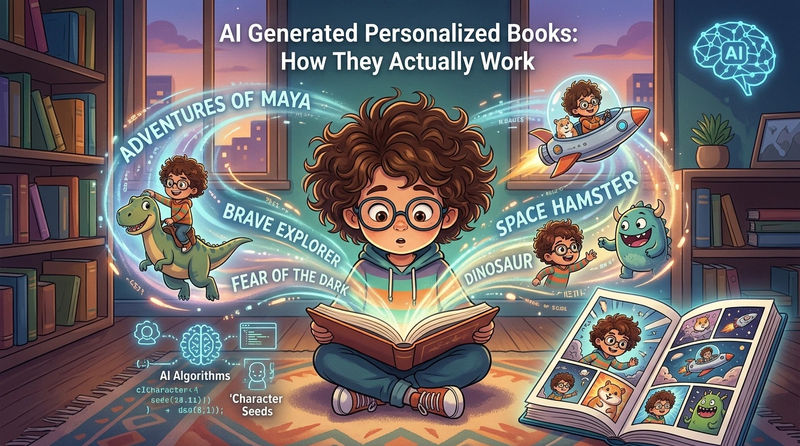
Generative AI removes that ceiling. Instead of filling a gap, you hand it ingredients — "a brave girl named Maya," "a fear of the dark," "a space-traveling hamster" — in plain English, and it bakes an entirely new narrative around them. The old way swaps Sarah for John in the identical story. The AI way builds John a pirate ship powered by his favorite food, because you asked it to.
Our take: that shift is the whole point, and it is bigger than it sounds. A child who sees themselves — their real traits, their real obsessions — accurately reflected in a story does not just enjoy it more; they read it as quiet proof that their world is worth a book. A name in a blank never did that. A story that is genuinely theirs does.
How to Make One Yourself: The 4-Step Recipe
Knowing what AI can do is the exciting part; getting an actual book out of it takes a recipe. The good news is the whole thing breaks into four bite-sized steps, and not one of them asks you to draw.
- Input — Hand a text generator like ChatGPT your starting prompt: the character names and the core idea or lesson. This is you handing the digital chef the ingredients.
- Plotting — Read the first draft and direct revisions until it fits. Too scary? Ask for sillier. Missing the mark? Add the favorite toy. You are the director here, and this is where your kid's actual personality gets onto the page.
- Illustrating — Feed the best scenes into an AI image generator as visual prompts and let it render the art — "rendering" being the polite word for turning your sentence into a finished picture.
- Finalizing — Drop your polished words and new pictures into a basic layout tool or photo-book site, and you have a book.
It is genuinely satisfying, and for the right person a lovely weekend. It is also where the catches start — because step three has a quiet habit of sabotaging step one.
The Catch Nobody Mentions: Your Hero Keeps Changing Faces
Nothing breaks the spell faster than a hero who swaps curly red hair for blonde pigtails somewhere around page six — a continuity error a five-year-old will catch before you do, and then bring up forever. It happens because the computer treats every prompt as a blank canvas. Ask it for "the knight" ten times and you get ten different knights, each fully convinced it is the right one.
The fix is a thing called visual memory, anchored by a "character seed" — a digital reference code that tells the system to keep the same face, hair, and outfit every single time. With that locked in, your kid's likeness can ride a dragon on page two and tramp through a jungle on page ten without quietly becoming a different child in between.
This is the step most DIY guides wave at and hurry past, and it is exactly the part that separates "a charming experiment" from "a book that looks like it came from a shop." Worth knowing before you promise anyone a finished product by bedtime.
Aim the Story at Something That Actually Matters
Here is where personalized AI books stop being a novelty and start being useful. You can find a children's book about sharing. You cannot find one about your child specifically sharing the blue train with the new baby sister who turned up last month and rearranged the entire household — that book does not exist, because no publisher prints for an audience of one.
AI does. Hand it the exact situation and it will build a comforting adventure around it: the nervous first dentist visit, the long campaign of potty training, the big feelings of moving to a street where they know nobody yet. The interest hooks them; the lesson does its work quietly in the background. Done well, the book becomes a custom teaching tool wearing the disguise of the best story on the shelf — which is a far easier sell at bedtime than a lecture with a moral.
From Screen to Shelf: Print Without the Headache
A book that only exists on a screen is a nice PDF, not a keepsake. Print-on-demand (POD) closes that gap: instead of a publisher running off a thousand copies, services like Blurb or Lulu print exactly one, just for you, with no bulk order required. Expect roughly $15 to $30 for a hardcover, and about a week to your door.
Before you hit print, a quick quality checklist saves you from a sad, floppy result:
- Paper weight — choose 80lb or 100lb so those vibrant pages do not ghost through to the other side.
- Binding — go for a sturdy "case wrap" hardcover, because it will be read by hands that have not yet mastered the concept of "gently."
- Finish — a glossy cover makes the artwork genuinely pop.
Get those three right and the finished book passes the only test that matters: it feels like something you bought, not something you exported.
A Quick Word on Safety
One part is worth slowing down for. You are feeding details about your family into someone else's software, so protect your footprint: use nicknames instead of real names, describe your child in words rather than uploading photos, and switch off data-sharing so your story is not quietly used to train the next model.
And keep a human in the chair. AI handles the heavy lifting, but you are the final editor — read every page and make sure the tone matches your values, not just the algorithm's best guess. Where the art is concerned, lean toward platforms that train on ethically licensed work. The magic is real, and it is better when it is also responsible.
The Shortcut: Skip the Software, Keep the Magic !
So here is the honest verdict. Making an AI personalized book yourself is a real, rewarding project — if you have the evening free, the patience for character-seed wrangling, and a genuine itch to play director. Plenty of people do, and they should absolutely go for it.
But most people do not want a second job as a layout designer. They want the result: a one-of-a-kind, professionally finished book starring someone they love, without the writer's block, the shape-shifting hero, or the privacy homework. And of all the formats this works in, a comic is the one built for it — heroes, panels, a story with momentum, and a kid who cannot wait to turn the page.
That is exactly what we built My Life in Comics for. You answer a few guided questions about the person and the moments that matter, and our AI inks those real details into a 32-page, high-definition comic — the same from-scratch, genuinely-theirs result, minus the software, the rendering, and the 11 p.m. argument with a chatbot about whether knights are allowed to have red hair.
See how it works on Our Services, make your kid the star with a Kids Hero comic, or jump straight in.
More Articles
View all articles
Unique Graduation Gifts: The Ones They Actually Keep (and the One Most People Miss)
Cash gets spent, the engraved watch gets shelved, and three relatives already bought the same earbuds. Discover the unique graduation gifts a grad actually keeps — and why a custom comic book that makes them the hero of their own story beats the entire gift table.

When Do Kids Learn to Read? The Honest Timeline (and the Trick Most Parents Miss)
Worried your kid is 'behind'? Here's the honest answer to when do kids learn to read — the real milestones from ages 4 to 7, what actually speeds things up, and why comic books and custom books for kids are the reading on-ramp most parents underrate.

Unique Wedding Present for a Couple: The One Gift They Can't Regift
The gift table is a sea of identical boxes and the registry is already picked clean. Discover the unique wedding present for a couple that can’t be regifted, returned, or duplicated by three other guests — and why the best personalized wedding gifts tell the couple’s own story.

Why Personalized Corporate Gifts Boost Employee Morale (And the One Most Companies Miss)
Branded water bottles do not move morale. Discover why personalized corporate gifts actually lift employee morale — and why a comic about the person beats one more thing with the logo on it.