When Do Kids Learn to Read? The Honest Timeline (and the Trick Most Parents Miss)
Worried your kid is 'behind'? Here's the honest answer to when do kids learn to read — the real milestones from ages 4 to 7, what actually speeds things up, and why comic books and custom books for kids are the reading on-ramp most parents underrate.
Somewhere around your child's fourth birthday, a quiet panic tends to set in. The neighbour's kid is apparently "already reading chapter books." A relative asks, a shade too casually, whether yours is "reading yet." And at some point you find yourself googling when do kids learn to read at 11pm, as though the answer is a deadline you have already blown.
Here is the relief, right up front: it is not a deadline. Learning to read is one of the genuinely magical things a small human does, and almost none of it runs on a fixed schedule. Most kids learn to read somewhere between the ages of 4 and 7 — and "somewhere between 4 and 7" is quietly doing an enormous amount of work in that sentence.
This is a calm, honest guide to the whole timeline: what age kids actually learn to read, the stages they move through on the way, what genuinely speeds things up (it is not flashcards), and the one trick that turns a reluctant reader into a kid smuggling a torch under the duvet at bedtime. That last part involves comics — and quite possibly your own child as the hero.
What Age Do Kids Learn to Read? (It's a Range, Not a Deadline)
Our take, before a single number: when do kids start reading is the most over-asked and least useful question in early childhood. The real answer is a range so wide it should come with its own area code — and a child landing at either end of it is completely, boringly normal.
Still, parents like a map. So here is the rough terrain for what age kids learn to read:
- Around age 3 — recognises a few familiar letters and requests the same bedtime book for the 400th consecutive night.
- Age 4 — works out that the squiggles actually mean something, and may "read" a memorised favourite word-for-word while holding it upside down. Let them. It counts.
- Age 5 — names most letters of the alphabet and starts sounding out simple words.
- Age 6 — reads simple books and begins to grasp how a story is shaped.
- Age 7 — reads straightforward sentences with real fluency and growing confidence.
If your five-year-old is not sounding out words yet, you have not missed a deadline; you have a five-year-old. The range exists because children are people, not printers — and people insist on arriving in their own time.
The Stages of Learning to Read (and Why Yours Won't Go in a Straight Line)
Reading does not show up in one cinematic moment where a child looks up from a book with tears in their eyes. It is built in layers, each one quietly laying the ground for the next.
- Pre-literacy (ages 1–3) — exploring books, loving being read to, recognising the odd letter. Chewing the corner of the book counts as engagement, technically.
- Emergent literacy (ages 3–4) — letters, rhymes, and the big realisation that print carries meaning.
- Early literacy (ages 5–6) — matching letters to sounds and reading short sentences out loud.
- Transitional reading (ages 6–7) — vocabulary expands, fluency improves, and they need less hand-holding per page.
- Fluent reading (age 7 and up) — speed, accuracy, expression, and the ability to retell the plot in their own words, usually at the dinner table, in great detail, whether you asked or not.
Each layer rests on the one before it, which is exactly why progress almost never looks like a tidy upward line. Expect plateaus, the occasional dramatic leap, and at least one week where they appear to forget the letter G entirely. This is normal. Reading is a staircase, not an escalator.
What Actually Moves the Needle (Hint: Not Flashcards)
Here is the opinion we will happily defend: when your child learns how to read is mostly down to their own wiring — and the part you can influence is not drilling, it is exposure and enjoyment.
A few things genuinely shape the timeline:
- A language-rich home — lots of talking, reading aloud, and books within grabbing distance.
- A grown-up who reads with them, not just at them.
- Individual cognitive development — some kids simply pick it up faster, the way some walk early and some are in no hurry whatsoever.
- Access to varied, interesting reading material.
The unglamorous truth underneath all of that: a child who is read to every night and surrounded by books they actually like will, on average, get there sooner — and enjoy it far more — than one drilled with phonics flashcards over breakfast. Reading-as-chore is the single fastest way to raise a kid who can read but would really rather not. Protect the fun, and the skill tends to follow.
How to Support the Journey Without Turning It Into Homework
Supporting a new reader is genuinely one of the more rewarding gigs in parenting, right up until it curdles into nightly drills. Keep it light, and lean on these:
- Build a reading routine — Same-ish time, comfy spot, no pressure. Consistency beats intensity every time.
- Offer variety — Picture books, comics, silly poems, the back of the cereal box. Different formats keep a kid curious.
- Read together, not as a test — Take turns, do the silly voices, let them turn the pages too early.
- Praise the effort, not just the result — "You really worked that word out" lands better than a gold star for being naturally quick.
- Be caught reading yourself — Kids do as you do. Telling them reading is wonderful while scrolling your phone is a hard sell, and they know it.
Comic Books and Custom Books for Kids: The On-Ramp Most Parents Underrate
Time for the take we feel most strongly about. For years, comic books for kids got filed under "not real reading" — the literary equivalent of letting them have dessert first. We think that is exactly backwards.
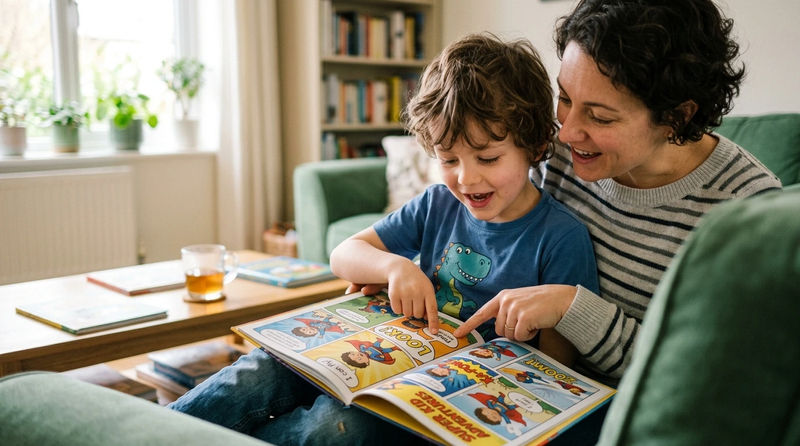
Comics are one of the best on-ramps to reading there is. The pictures carry some of the load, so a child who finds a wall of text intimidating gets to succeed on page one instead of stalling on it. They follow a story, decode the words, and read for the most powerful reason of all: they genuinely want to know what happens next. Graphic novels do the same thing at a higher level. If it gets them reading, it is real reading — full stop.
Custom books for kids take that same idea and pour rocket fuel on it. A personalised story that casts your child as the main character — using their name, their best friend, their slightly chaotic dog — turns reading from a task into a thing that is unmistakably about them. Suddenly "let's read" is not a negotiation; it is the best offer on the table.
A good mix to keep on the shelf:
- Comic books and graphic novels — visuals that keep stories lively and lower the barrier to entry.
- Custom or personalised books — reading feels relevant and exciting when the hero shares your kid's name.
- Audiobooks — brilliant for modelling fluency and expression on a long car ride.
- Interactive e-books — variety for the days a paper book is somehow the enemy.
How to Improve Reading Comprehension for Kids (Without the Quiz Energy)
Decoding the words is only half the job; the other half is understanding them. The good news is that improving reading comprehension for kids does not require a clipboard. Nobody, of any age, enjoys a surprise pop quiz at the end of a bedtime story.
Instead, keep it conversational:
- Ask genuine questions — "Why do you think she did that?" beats "What colour was the dog?"
- Talk about the characters and setting — Treat the story like gossip about people you both happen to know.
- Make predictions — "What do you reckon happens next?" turns a passive reader into an active one.
- Have them retell it — Putting the story into their own words is the clearest sign it actually landed.
- Read often, and read widely — Range builds comprehension better than re-reading the same five books, much as your child may lobby otherwise.
When to Stop Worrying — and When to Actually Get Help
Most of the time, "behind" is not behind; it is simply a different, perfectly valid spot on a very wide range. Patience and encouragement do far more good than anxiety ever has.
That said, trust your instincts. It is worth a conversation with a teacher, paediatrician, or reading specialist if your child consistently struggles to decode words, shows little progress over a long stretch despite regular practice, reads much more slowly than their peers, or keeps missing the meaning even when the words come out right. None of these means something is wrong — but early support, when it is genuinely needed, makes a real and lasting difference. Asking is never an overreaction.
Put Your Kid in the Story
If we have one verdict to leave you with, it is this: the single most reliable way to make a child want to read is to make them desperate to find out what happens next — and nothing does that faster than handing them a story where the hero has their name.
That is exactly what we built My Life in Comics to do. You answer a few guided questions about your child — their world, their sidekick, the adventure you want them to star in — and our AI turns it into a high-definition, full-length comic book with them on every page. It is not a substitute for storytime or school; it is the thing that gets a reluctant reader to open the cover on their own, which is where the whole magical business of learning to read quietly begins.
See how it works on Our Services, browse Family Memory comics for more story-driven ideas, or jump straight in.
Plus d'articles
Voir tous les articles
Unique Wedding Present for a Couple: The One Gift They Can't Regift
The gift table is a sea of identical boxes and the registry is already picked clean. Discover the unique wedding present for a couple that can’t be regifted, returned, or duplicated by three other guests — and why the best personalized wedding gifts tell the couple’s own story.

Why Personalized Corporate Gifts Boost Employee Morale (And the One Most Companies Miss)
Branded water bottles do not move morale. Discover why personalized corporate gifts actually lift employee morale — and why a comic about the person beats one more thing with the logo on it.

5 Must-Try Comic Maker Tools for Beginners (And the Shortcut to Your Own Comic)
New to comic making? Discover the 5 best beginner-friendly comic maker tools, how to choose a comic book creator, and the fastest way to turn your comic ideas into a finished book.
The "Multiverse" of Your Life: Why One Comic is Just the Beginning
A personalized comic does not have to be a one-and-done gift. Discover how to turn your memories into a connected series of life chapters, character issues, and hidden-puzzle adventures.